
Inside a BRAC School:
Mission, Curriculum & Child-Friendly Learning
"A BRAC classroom is not a place where children are taught. It is a place where children discover that learning is joyful."
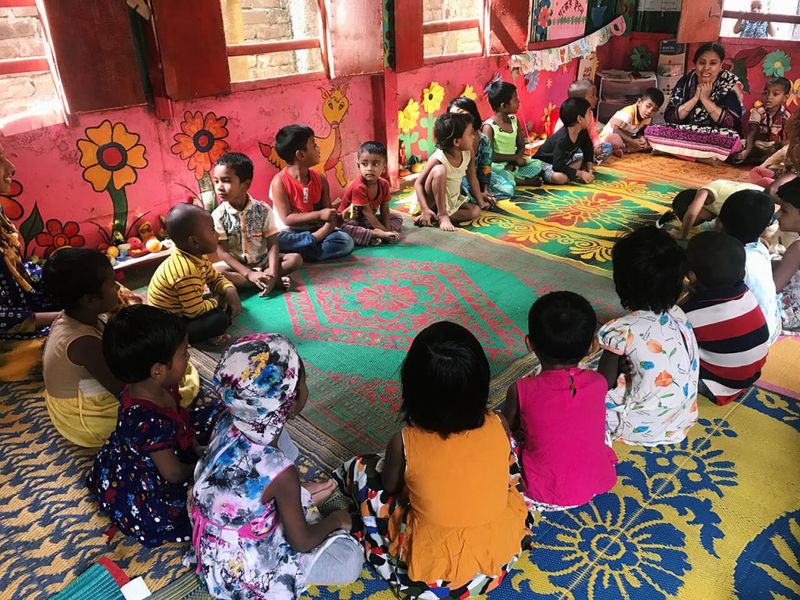
Step into any BRAC school — whether it is a bamboo-walled room in a remote village, a colourful Play Lab in an urban slum, or a bright classroom in a refugee camp — and you will notice something immediately: the children are smiling. They are singing. They are playing. And they are learning at the same time.
This is no accident. Every element of a BRAC school — from its mission and vision to its curriculum, class structure, and inclusive practices — is intentionally designed to make education joyful, child-friendly, and accessible to all. Let us take a closer look at what makes a BRAC school tick.
1. Our Mission & Vision: Education as Joy
At the heart of every BRAC school lies a simple but powerful belief: education should not be a burden. It should be a joy.
🎯 The Mission
BRAC's education mission is to create joyful, child-friendly, and quality learning opportunities for every child — especially those who are excluded from the formal system. This means:
- Building classrooms where children feel safe, respected, and happy
- Delivering lessons that are engaging, interactive, and meaningful — not rote memorization
- Ensuring that poverty, gender, disability, and geography are never barriers to learning
- Preparing children not just for exams, but for life — with confidence, creativity, and critical thinking
🔭 The Vision
BRAC envisions a world where every child realizes his or her full potential through education. This vision goes beyond literacy and numeracy. It is about nurturing the whole child — intellectually, emotionally, socially, and physically.
2. Curriculum & Learning Methods: Learning by Doing
BRAC's curriculum is carefully aligned with Bangladesh's National Curriculum and Textbook Board (NCTB) standards. But here is the difference: while the destination is the same as formal schools, the journey is entirely different.
📚 National Curriculum Alignment
BRAC schools follow the national curriculum for core subjects:
- Bangla (language and literature)
- English (basic communication and grammar)
- Mathematics (numeracy, problem-solving, and logic)
- Science (environmental science, health, and natural phenomena)
- Social Studies (history, geography, and civics)
- Religious Studies (moral and ethical education)
However, BRAC compresses the traditional 5-year primary curriculum into 4 years through an accelerated, activity-based approach — designed specifically for out-of-school children who need to catch up quickly.
🎭 Experiential Learning: Play, Rhymes & Songs
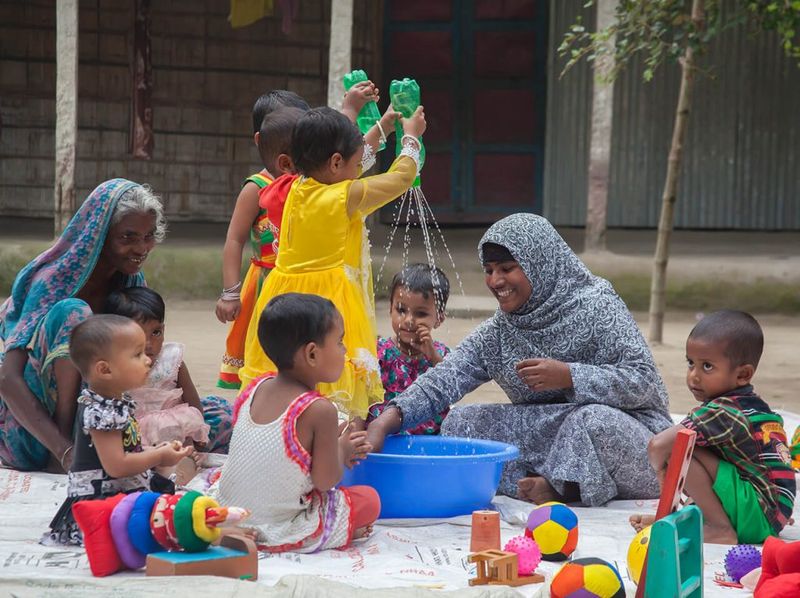
What truly sets BRAC apart is its experiential learning methodology. Children do not sit in rows memorizing textbooks. They learn by doing, playing, singing, and discovering.
Key Teaching Methods
- Play-based learning: Educational games, puzzles, and role-playing activities that teach math, language, and social skills through fun
- Rhymes and songs: Bangla and English rhymes are used to teach vocabulary, pronunciation, rhythm, and memory
- Storytelling: Teachers narrate stories with puppets, props, and expressive voice modulation to build comprehension and imagination
- Group activities: Children work in small teams on projects, fostering collaboration, communication, and peer learning
- Hands-on experiments: Simple science experiments using everyday materials — like growing plants in bottles or measuring rainfall
- Art and craft: Drawing, painting, clay modelling, and paper crafts that develop fine motor skills and creative expression
- Movement and dance: Physical activities and folk dances integrated into lessons to keep children active and engaged
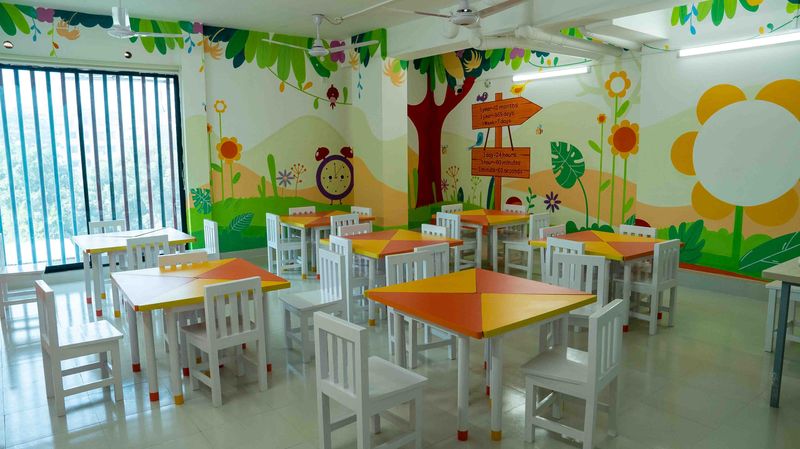
The classroom itself becomes a learning tool. Walls are covered with colourful charts, student artwork, and alphabet banners. The floor is often a mat where children sit in a circle — equal, connected, and ready to participate. There are no front-row or back-row students. Every child is in the centre.
3. Class-Based Structure: From Pre-Primary to Primary
BRAC's education programme is structured as a seamless journey from early childhood to primary completion, ensuring that no child falls through the gaps between stages.
🧸 Pre-Primary Education (Age 5+)
The foundation of everything. BRAC's pre-primary programme prepares children for formal schooling through:
- School readiness: Basic literacy, numeracy, and social skills
- Routine building: Teaching children to sit, listen, share, and follow simple instructions
- Hygiene habits: Handwashing, personal cleanliness, and health awareness
- Play-based introduction to learning: Through songs, games, and interactive storytelling
Over 6 million children have graduated from BRAC pre-primary programmes, with approximately 61% being girls. The transition rate to primary school is exceptionally high.
📖 Non-Formal Primary Education (Age 8–14)
This is the core academic programme, designed for out-of-school children who have never enrolled or have dropped out. It covers:
Primary Curriculum Structure (4-Year Cycle)
- Year 1: Foundational literacy and numeracy, basic environmental awareness, and social skills
- Year 2: Expanded reading and writing, arithmetic operations, introductory science, and community awareness
- Year 3: Advanced comprehension, problem-solving, health and hygiene, and national heritage
- Year 4: Preparation for the Primary Education Completion (PEC) examination — integrated revision, exam skills, and transition readiness
Upon successful completion, students sit for the government Primary Education Completion (PEC) examination and receive a certificate equivalent to formal primary education. They then transition into secondary schools — government, private, or BRAC-supported.
🎓 Secondary Education Support
BRAC does not stop at primary. It supports rural secondary schools by:
- Building teacher capacity through training and mentoring
- Improving classroom pedagogy and learning environments
- Providing digital resources and learning materials
- Monitoring quality and student outcomes
4. Inclusive Education: Every Child Belongs
A BRAC school is not truly child-friendly unless it welcomes every child — including those with physical, sensory, intellectual, or developmental challenges. BRAC's inclusive education programme ensures that disability is never a reason for exclusion.
♿ Special Teaching Arrangements
BRAC provides a range of accommodations to ensure children with special needs can learn alongside their peers:
Inclusive Support Systems
- Individualized Education Plans (IEPs): Tailored learning goals and pacing for each child based on their abilities
- Adapted teaching methods: Simplified instructions, visual aids, tactile learning tools, and multi-sensory approaches
- Sign language support: Teachers trained in basic sign language for deaf and hard-of-hearing students
- Braille materials: Textbooks and reading materials converted to Braille for visually impaired learners
- Assistive devices: Wheelchairs, hearing aids, white canes, and other equipment provided free of cost
- Peer buddy systems: Classmates are encouraged to support and include children with disabilities, building empathy from an early age
🏫 Accessibility in the Classroom
BRAC works to make the physical learning environment accessible:
- Ramp installations for wheelchair users
- Wide doorways and unobstructed pathways within the classroom
- Seating arrangements that place children with visual or hearing impairments near the teacher
- High-contrast, large-print materials for children with low vision
- Quiet spaces for children who become overwhelmed by noise or crowds
👨👩👧 Parental & Community Support
Inclusion does not stop at the classroom door. BRAC actively engages parents of children with disabilities through:
- Counselling on their child's rights and potential
- Training on how to support learning at home
- Connecting families with disability services and government entitlements
- Community awareness campaigns to reduce stigma and discrimination
5. Conclusion: A School Designed for Children
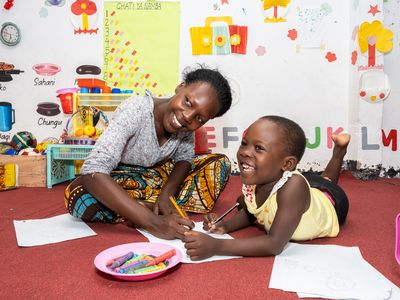
BRAC's academic model is a masterclass in what happens when an organization truly puts children first. The mission is not about building impressive institutions — it is about creating spaces where children feel safe, happy, and inspired to learn.
The curriculum does not chase test scores at the expense of creativity — it balances national standards with experiential, play-based methods that children actually enjoy. The class structure ensures a smooth journey from early childhood to secondary transition. And the inclusive practices prove that quality education is meaningless unless it reaches every single child.