
BRAC Schools:
A Second Chance at Education in Bangladesh

"Every child deserves a second chance. BRAC School is where that chance begins."
In the crowded slums of Dhaka, on the floating chars of the Jamuna River, in the remote tea gardens of Sylhet, and in the shadow of the world's largest refugee camp in Cox's Bazar, there are children who have already lost their first chance at education.
They are the dropouts — pulled out of school by poverty, by the death of a parent, by the need to work instead of learn. They are the orphans — with no one to pay for their books, no one to advocate for their future. They are the helpless — children with disabilities hidden away at home, children from families too poor to afford a pencil, children from communities where girls are told that school is not for them.
For these children, the formal education system has often already said "no." But BRAC School says "yes."
BRAC School is not just an alternative school. It is a second chance — a lifeline thrown to children who were drowning in the gaps of Bangladesh's education system. And over the past four decades, it has become one of the most powerful forces for educational equity in the developing world.
1. Who Needs a Second Chance? The Children BRAC School Serves
Before we understand how BRAC School works, we must understand who it works for. These are not children who simply prefer a different type of school. These are children for whom the traditional system has failed — or was never accessible to begin with.
The Dropouts
Bangladesh has made remarkable progress in primary school enrollment. But dropout remains a silent crisis. Every year, thousands of children leave school before completing primary education. The reasons are painfully ordinary: a father loses his job, a mother falls ill, a family migrates for work, or a harvest fails. Suddenly, the child who was sitting in Grade 3 is now herding cattle or caring for younger siblings.
BRAC School exists to find these children, bring them back, and help them catch up — often compressing five years of learning into four through an accelerated, child-friendly curriculum.
The Orphans & Vulnerable
For children who have lost one or both parents, education is rarely a priority. Survival is. Orphans in Bangladesh often end up in child labour, domestic work, or on the streets. Without a guardian with the time, money, or authority to enroll them in school, they simply slip through the cracks.
BRAC School actively seeks out these children through community mapping, orphanage partnerships, and referrals from local government. It removes every barrier — fees, materials, distance — so that a child's orphan status does not determine their educational fate.
The Helpless & Marginalized
This category includes children with disabilities who are turned away from mainstream schools, children from ultra-poor families living on less than $1.90 a day, children from ethnic minority communities who do not speak Bangla at home, and children living in disaster-prone or geographically isolated areas where no formal school exists.
For these children, BRAC School is often the only classroom they will ever enter.
2. How BRAC School Delivers a Second Chance
BRAC School's genius lies in its radical simplicity. It does not try to replicate the formal system. It reimagines it entirely — stripping away every barrier that keeps vulnerable children out of school.
🏠 The One-Teacher, One-Room, One-Cohort Model
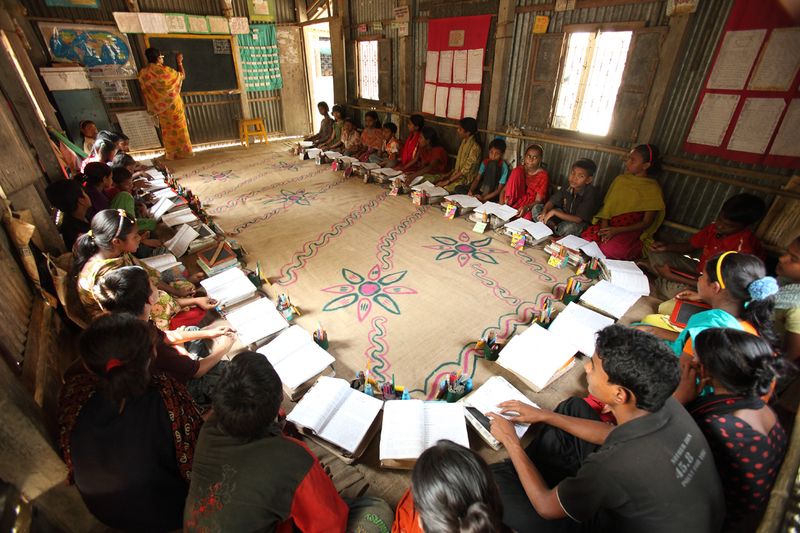
At the heart of BRAC School is a model so simple it seems almost too basic to work — yet it has educated millions:
- One Teacher: A local woman, often from the same village, with 10–12 years of schooling. She is not a subject specialist — she is a mentor, guide, and advocate for every child in her care
- One Room: A rented space in the community — a villager's front room, a bamboo hut, or a community centre. No expensive buildings. No long commutes
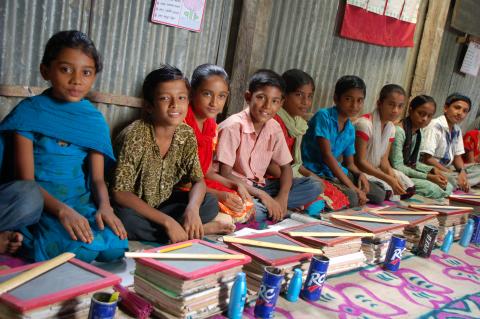
- One Cohort: 25–33 children who stay together for the entire primary cycle. The teacher knows every child's name, family situation, learning pace, and dreams
This model costs approximately $45 per child per year — a fraction of what formal schools spend — yet produces learning outcomes that match or exceed government schools.
📚 The Accelerated Curriculum
BRAC School follows Bangladesh's national curriculum but delivers it in an accelerated 4-year cycle instead of the traditional 5 years. This is critical because out-of-school children are often already behind — they cannot afford to spend extra years catching up.
The teaching methods are experiential and joyful:
- Children learn math through games and real-life problems
- They learn language through rhymes, songs, and storytelling
- Science is taught through hands-on experiments with everyday materials
- Art, drama, and movement are woven into every subject
🆓 Zero Cost to Families
BRAC School is entirely free. Every child receives:
- Free textbooks and exercise books
- Free pens, pencils, and learning materials
- Free tuition — no fees, no hidden costs
- Flexible timing that fits around family needs
3. The Journey: From Project to Permanent Promise
BRAC School's story is not one of continuous expansion. It is a story of commitment — including the courage to pause, reflect, and restart stronger.
🚀 2008: The Beginning
In 2008, BRAC formally launched BRAC School as a dedicated initiative targeting the most vulnerable children in Bangladesh. Operating as a project-based programme with defined donor cycles, it opened schools in ultra-poor pockets, disaster-affected regions, and areas with high dropout rates. The model worked. Children who had been out of school for years were reading and writing within months.
⏸️ 2018: A Necessary Pause
By 2018, the original BRAC School project reached the end of its funding cycle. As donor priorities shifted and the project phase concluded, the standalone BRAC School initiative was formally wound down. But BRAC's commitment to vulnerable children never stopped — it continued through broader NFPE, pre-primary, and adolescent programmes. The pause was not an ending. It was a period of learning and preparation.
🔥 2025: The Restart — Permanent & District-Based
In 2025, BRAC made a historic decision: BRAC School would return — but this time, it would be fundamentally different. It was no longer a temporary project. It was reborn as a permanent, district-based institution with long-term community and government partnerships.
Under the new model:
- Operations are managed at the district level — allowing localized responses to local needs
- Teachers are recruited from within the same district
- Local government bodies are full partners in identifying beneficiaries and providing support
- There is no project end date — BRAC School is now a permanent promise, not a time-bound intervention
4. Why BRAC School Works: The Secrets of Success
BRAC School has been studied by the World Bank, UNESCO, Harvard University, and countless independent researchers. They all ask the same question: How does a low-cost, non-formal school system produce results that rival expensive formal schools?
👩🏫 The Teacher Who Cares
In a BRAC School, the teacher is not a distant authority figure. She is a neighbour. She visits children's homes when they are absent. She knows which child did not eat breakfast. She comforts the child who is being pressured to marry. This relational teaching is the single biggest reason children stay in BRAC School.
🏘️ Community Ownership
Every BRAC School has a School Management Committee (SMC) made up of local parents, elders, and volunteers. They do not just advise — they own the school. They ensure the teacher is present, the room is safe, and no child drops out without intervention. When the village owns the school, the school survives.
👧 Gender at the Centre
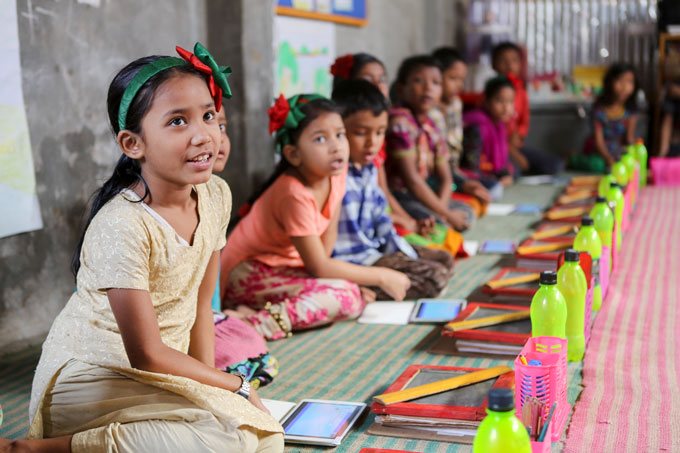
Over 50% of BRAC School students are girls — a remarkable achievement in a country where girls were once systematically excluded. BRAC achieves this by:
- Hiring female teachers that parents trust
- Locating schools within walking distance of homes
- Offering flexible timing that does not conflict with household chores
- Providing free materials so families do not have to choose between sons and daughters
- Actively intervening to prevent child marriage
🎯 Relentless Dropout Prevention
When a BRAC School child stops attending, the system does not wait. The teacher visits the home. The SMC mobilizes. If the issue is poverty, BRAC connects the family to social protection. If it is child marriage, BRAC intervenes with parents and elders. If it is illness, BRAC links them to healthcare. The result? A dropout rate of just 6% — compared to national averages of 20–30% in vulnerable areas.
5. The Numbers: Success That Speaks
The impact of BRAC School is not theoretical. It is measurable, verifiable, and extraordinary:
- 15+ million children educated through BRAC's education programmes since 1985
- 99.97% pass rate in government Primary Education Completion (PEC) examinations
- 50%+ female enrollment — challenging deep-rooted gender barriers
- 6% dropout rate — among the lowest for non-formal education globally
- 65%+ of graduates successfully transition to secondary school
- Replicated in 6 countries — Afghanistan, Pakistan, Uganda, Tanzania, South Sudan, and Liberia
But numbers do not capture the full story. They do not capture the moment a 12-year-old dropout reads her first full sentence. They do not capture the pride of an orphan who graduates and becomes a teacher herself. They do not capture the village that transforms because its daughters are now in school.
6. Conclusion: A Second Chance Is a Human Right
BRAC School teaches us something profound: it is never too late for a child to learn. A child who drops out at age 10 is not a lost cause. An orphan with no books is not beyond help. A girl told she belongs at home, not at school, deserves to have that lie challenged.
BRAC School is the challenger. It is the institution that looks at the children the world has given up on and says: "You are worth investing in. You are worth educating. You are worth a second chance."
From its launch in 2008, through its pause in 2018, to its powerful restart as a permanent, district-based system in 2025, BRAC School has evolved. But its essence has never changed. It is still a room in a village. A teacher who cares. A child who thought their chance was gone — until they walked through the door.